
BundleBleed
BundleBleed — a knight bleeding JS from a blade

Extract · Analyze · Hack Better

Turn a pile of JS bundles into leads worth testing.

You can extract 5,000 endpoints from JavaScript. Finding the 3 that actually lead to a vulnerability? That's the problem BundleBleed solves. One command collects every JS file passively, runs 12 extractors in parallel, scores every finding against known bug classes, and drafts your report — so you open the output and go straight to validation.

v1.0.0 Open source MIT Python 3.12+

576

tests passing

12

extractors running in parallel

57

secret patterns

0

exploitation attempts, ever
Most JS recon tools tell you what they found.
BundleBleed tells you which 3 things are worth your time.

The goal isn't to replace the hunter. It's to eliminate the work that keeps the hunter away from the actual investigation.

About

Recon that ends in a decision, not a spreadsheet.

One command. The pipeline collects every JS file passively (gau, waybackurls, waymore, getJS running simultaneously), runs 12 extractors in parallel, scores every finding with a deterministic multi-signal hypothesis engine, and optionally drafts your report and attack chains via AI (Anthropic, Ollama, or OpenRouter). The core pipeline needs zero LLM or API key. AI never decides scope, sends a request, or closes a finding.

01

Collect

gau · waybackurls · waymore · getJS simultaneously. katana opt-in behind three gates.

02

Extract

12 extractors in parallel — endpoints, secrets, GraphQL, WebSockets, DOM sinks, source maps

03

Score

Hypothesis engine maps findings to bug classes with confidence scores — not a flat dump

04

Verify

Drafts the test. Only a human ever fires the request — always.

05

Report

AI drafts the writeup. JSON, Markdown, HTML dashboard, wordlists for Burp/ffuf/nuclei

Features

What it actually does, end to end.

Collection

Collection & scope

gau, waybackurls, waymore, and getJS run simultaneously — passive by default, nothing active without explicit opt-in. Katana active crawling gated behind a config flag, a CLI flag, and a signed scope.yaml attestation — all three. --seed-url injects known URLs for fresh SPA targets with no archive history. Every URL from every source passes through ScopeGuard with an audit-log row per decision.

Extraction

12 extractors, running in parallel

Secrets (57 patterns), endpoints, GraphQL schemas, WebSocket handlers, DOM sink/source chains, prototype pollution vectors, postMessage channels, Web Workers, auth config, comments, symbols, and dependencies — all in parallel. Source maps recovered and analysed so you're reading actual source, not minified noise. 69 known-vulnerable libraries matched against a pinned retire.js database.

Scoring

Hypothesis engine

Findings are scored and mapped to bug classes — not dumped. SSRF-shaped params, BOLA/IDOR endpoints, JWT alg:none, CORS misconfigs, Firebase open DBs, supply chain scripts, auth regression, feature flags, DOM-XSS patterns. Confidence blends static match, authenticated-context, cross-scan repetition, and runtime-confirmed evidence. AI contribution is capped — never AI alone.

Human gate

Verification, always human-fired

IDOR/BOLA hypotheses get a drafted curl/http test with placeholder cookies. Hardcoded-credential hypotheses get a liveness command — the raw value is never stored or sent. Object authorization processor flags BFLA and mass-assignment patterns. The tool never sends any request itself; only a human via verify record changes a hypothesis's status.

AI layer

AI-powered analysis, on a leash

bundlebleed ai report drafts a human-readable writeup from scored evidence. bundlebleed ai chains maps multi-step attack paths across findings. --ai on scan classifies endpoints. Provider-agnostic: Anthropic Claude, self-hosted Ollama, or OpenRouter. Every claim must cite a real evidence ID — a hallucinated citation is a hard failure, not a warning.

Reporting

Reports built for the next step

JSON, Markdown, and a self-contained HTML dashboard — no CDN, works over file://, sortable and filterable. Plain-text wordlists ready to feed ffuf, httpx, Burp Intruder, or nuclei. OpenAPI 3.0 export from collected endpoints. Scan history, cross-run diffing, and webhook alerts only when access control or secrets actually regress.

Safety model

Built for scoped, authorized testing — not exploitation.

Every guarantee below is enforced in the code, not left to a flag someone forgot to check.

Guarantee What it means
No exploitation, everNot a config option — there is no code path that exploits anything.
Scope-gated by constructionEvery outbound request passes through one ScopeGuard choke point, with an audit-log row per decision.
Passive by defaultActive scanning needs a config flag, a CLI flag, and a signed scope.yaml attestation — all three.
AI has no authorityIt classifies and drafts only. A hallucinated citation is a hard failure, not a soft warning.
Evidence is data, never instructionScanned content is treated as attacker-controlled and is never obeyed.
A human approves everything outboundVerification requests, reports, and alerts are all drafted — only a human sends.
Secrets redacted at ingestType, preview, and a partial hash only — the raw value is never written to disk.

It never automates login, never decides scope, never fuzzes or brute-forces, and never writes (POST/PUT/DELETE) to a target under any flag.

Get started

Install, scan, and read the wordlists.

Requires Python 3.12+ and uv. Every command supports -h / --help.

install & first scan
$ git clone https://github.com/shaikarifali/bundlebleed && cd bundlebleed $ uv sync # passive-only scan — gau, waybackurls, waymore, getJS run simultaneously $ uv run bundlebleed scan -t example.com -o results/ # with AI: drafts report and attack chains (Anthropic / Ollama / OpenRouter) $ uv run bundlebleed scan -t example.com -o results/ --ai --ai-model <your-model> # draft a vulnerability report from a scored hypothesis $ uv run bundlebleed ai report <hypothesis-id> -o results/ # map multi-step attack chains across all findings $ uv run bundlebleed ai chains -o results/
Command What it does
bundlebleed scanCollect, extract, and score a target into ranked hypotheses.
bundlebleed monitorRe-scan on an interval and alert only when access control, secrets, or endpoint shape actually regress.
bundlebleed scope check / listValidate a single URL against scope, or print the fully resolved scope and exclusions.
bundlebleed verify diff / recordCompare two captured responses locally, then record a human-confirmed outcome — the only way a hypothesis's status changes.
bundlebleed ai report / chainsDraft a writeup from scored evidence, or surface plausible multi-step attack chains — pure analysis, nothing sent.
bundlebleed export openapiEmit a valid OpenAPI 3.0 document from collected endpoint findings — no network activity.

Full flag reference, detection-pattern catalog, and all CLI options in the README — or run bundlebleed --help for everything inline.

Speaking

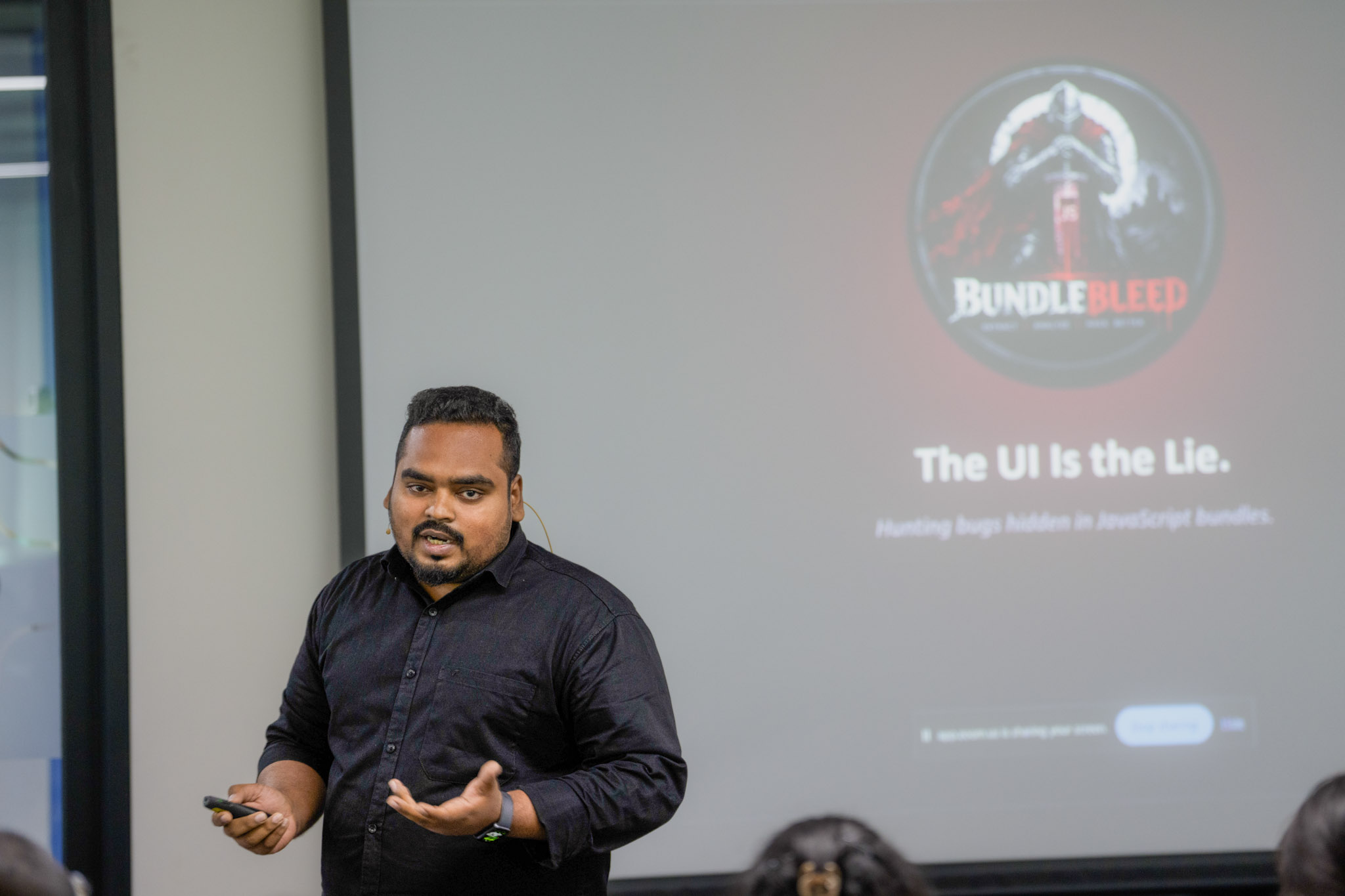
The UI Is the Lie: Hunting Bugs Hidden in JavaScript Bundles

A talk at null Hyderabad on why the rendered UI hides the real attack surface, and how to pull endpoints, secrets, and DOM-XSS-shaped sinks straight out of a target's JS bundles — the ideas that became BundleBleed.

View session on nullHyd →
Shaik Arif Ali presenting "The UI Is the Lie" — a talk on hunting bugs hidden in JavaScript bundles, with the BundleBleed logo projected behind him